 Wood
Gas
Stoves
Wood
Gas
StovesWood gas stoves are stoves that heat wood or other biofuel, and then burn the flammable gas that is released. This essentially burns the smoke , resulting in a fire that is at once much cleaner and much more efficient than conventional wood stoves. This process transforms most of the fuel into charcoal, which can then be burned as fuel at a later date or incorporated into soil where it can greatly increase fertility and sequester carbon for thousands of years. Wood stoves have leapfrogged from being among the world's biggest ecological problems to being a very important part of the solution . I've collected some resources to help people understand this process and the promise that it holds.
| TLUD
stands for Top Lit Up Draft and is an important term and concept for
wood gas stoves. This video silently explains the concept and
application. It's by Paul Anderson, a retired geography
professor who has worked a lot with stove designs for Africa. Here is a link to his page on stove design. Here is the description for this video: "Top-Lit UpDraft (TLUD) stove designs use modern gasification technology in small containers for exceptionally clean burning of inexpensive or free chunky, dry, biomass fuels. This helps overcome the fourth worst health problem (respiratory diseases) in Least Developed Countries (LDC). " |
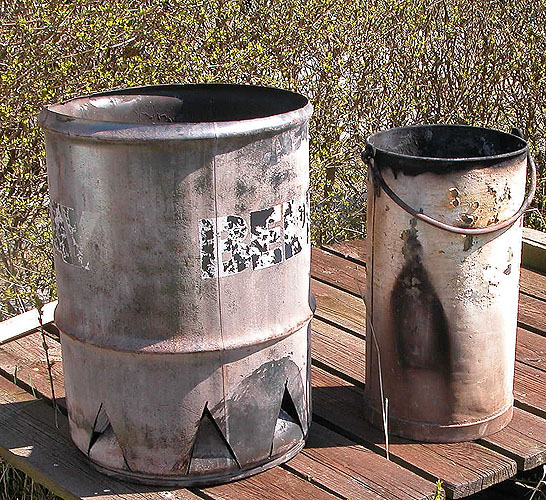 |
To understand this process,
it helps to start with a simple model such as Folke Günther's simple charcoal
retort.
On his site he shows how h e fills the smaller can with wood
blocks, then turns it upside down on top of a couple of bricks he has
spread apart a bit, and then he and then he turns the bigger
can
upside down over top of it. Then he cleverly puts his hand
underneath the wood and the other on top of the big can and
flips
the whole arrangement. He fills the gap between the cans with
kindling , lights it from the top and leaves it for a while.
When
he comes back the flame is no longer smoking as it is fueled by burning
wood gas instead of wood, and he gets a wok and cooks up a
beautiful meal right out of the garden that the whole
operation
takes place in. After the fire cools, he has a
signifcant
amount of biochar in the small can, so the meal
carbon
negative and he makes fertilizer in the process. Here is his page on Carbon dioxide negative cooking |
|
|
This
is a very good intro into the vast world of recycling various sizes of
empty food cans into various sizez of stoves . This
guy has some other nice videos, and if you click on the up arrow at the
bottom right of the screen, then coose the lowest icon, a
scrolling list of related videos comes up. Click on one and it opens
here. There are forges, home heating stoves, cook
stoves, and camp stoves made out of all manner of recycled containers.
|
 |
|
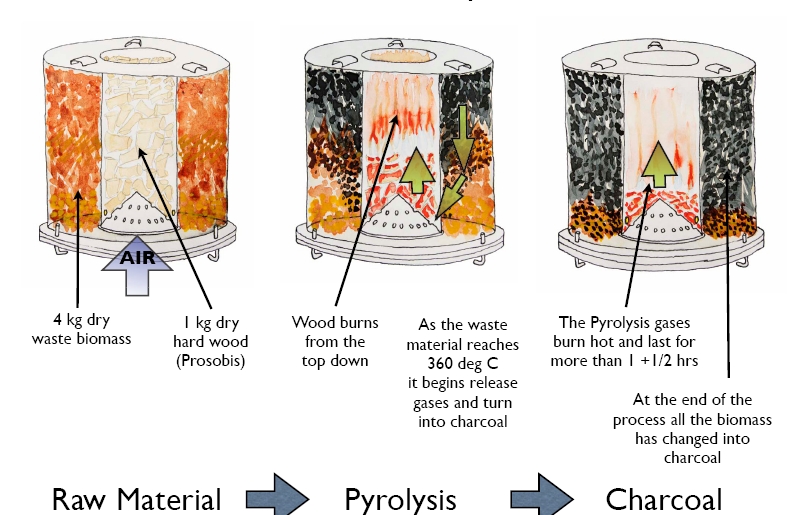
The anila stove was develped by Professor U.N. Ravikumar of Mysore university in Tamil Nadu which is being promoted in south Asia andAfrica by developmental agencies. This site explaining the anila stove was done by our friend Folke Gunther from the previous panel, for a n organization addressing climate change in Africa. The page gives good instructions and detailed plans for making the stove and explains the need that it fills. Great site! I think it's funny Folke used a decorated christmans tree image to illustrate a tree, given the context. |
| This
is Larry Henson's cool little pop up wood gas
stove. His description says: "Compact biomass cooking stove needs only 150 grams of wood to cook 1.1 kilo of rice. It is a natural draft clean burning design, easy to use and easy to build from 4 cans. Designed for people in developing regions and for camping, emergency, disaster and survival situations, also for outdoor, off-grid cooking and green living." Check out his other videos. In this one he uses a larger stove made from metal buckets rather than cans. He uses 500 grams of wood cooks 7 liters of pintos for 3 hours......... Given the volatility of this meal when run through the average human's biodigester, i question the carbon negative rating! |
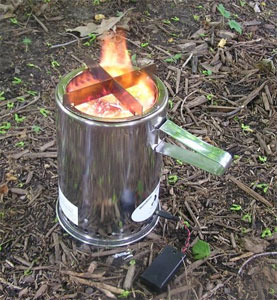 |
Dr
Tom Reed, a professor of Chemical Engineering at the Colorado School
of Mines, has been working on wood gas stoves since a visit to Africa
in 1985 when he discovered that much of the third world
cookied on smoky, inefficient wood
fires, often indoors. The smoke caused many serious health
problems
and the inefficiency cased the over cutting of forest resources.
Dr
Reed was a specialist in Wood Gasification, and realized his
gasification knowledge might provide a
solution to problems of developing world cooking. Over the years, he tinkered with various solutions, and by 2000 had built early prototypes of the WoodGas campstove. His company, Biogas Energy Foundation, now sells two sizes of stoves starting at $55. They use two AA batteries |
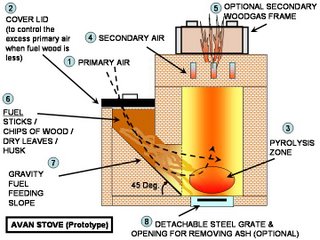 |
This
is one of the many stoves designed and built by Dr Sai Bhaskar Reddy Nakka.
Check out the stoves and articles on his website.
He is founder
of the Geoecology Energy Organisation (GEO) "An Initiative to
Mitigate Climate Change through Adaptation.
" The GEO has projects throughout India promoting better
stoves and biochar production. Notice the optional seconday woodgas frame at the top of the stove. With this added it burns the smoke and woodgas. Without it, it is a rocket stove. |